Categories
Radio Terminology

Radio Times

Question: What do a parrot and a walk through a bog
have in common?

Answer: They both make noises which are common radio terms in aviation.

In plane English (see what I did there!):

Squawk is a four-digit code given to the pilot by air traffic control (ATC). This establishes the aircraft on the air traffic controller’s radar screen and turns the random blip to an identified aircraft.

Once the pilot has been given the squawk code, he enters it into the plane’s transponder (a short of radio transmitter) which then emits the code to the world. Transponders have different ‘modes’ and can provide other useful information such as location and altitude.

Squelch is a function designed to minimise unnecessary radio noise. If you’ve ever heard the hiss and crackle of a transistor radio which isn’t quite tuned into the station you’re trying to listen to, this is what you’d get without squelch.

Ideally, squelch should be turned up just enough so that the background noise disappears and the station comes through nice and clear; too much squelch and you risk tuning-out the station you’re trying to listen to, too little squelch and you’ll have that constant hissing and crackling in the background. If the signal is weak, squelch will need to be minimised in an effort to get as much of the signal as possible.
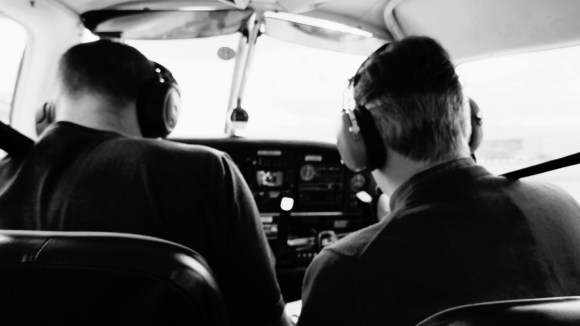

“Hey guys, while we’re still on the ground can we listen to Heart FM instead please?”
Categories
Radio

Under Pressure

It all started when I looked out of the study window and commented on the clouds scudding across the sky (what a great word – scudding!) I saw that look on Will’s face which told me that: a) we were about to embark on a weather-related discussion; and b) he was tearing his hair out staring at the computer screen and this was a welcome excuse to focus on something a lot more enjoyable than work.

From the weather outside, the obvious conversation would have been about clouds, precipitation or gusting wind but it wasn’t. It was about air pressure and how it’s used as a measure to indicate the altitude of the aircraft. When taking off and passing through different zones, the air pressure is given over the radio so that the altimeter can be corrected to the local setting. Set it wrong, and you could end up higher or lower than you, and air traffic control, think you are (gulp!)

There are two settings used for light aircraft, abbreviated to QNH (altitude above sea level) and QFE (height above ground level). Later that day – as I often come back hours later to mull these things over – I realised that I’d have to find some way of remembering which was which. I subsequently found that my guess of “Nautical Height” was correct. The other is “Field Elevation” (not “From Earth”!) I couldn’t think of anything relevant for Q, but then discovered that it’s a throwback to radiotelegraphy when three letter codes were developed, all starting with Q, to save time and avoid confusion. It’s certainly quicker to say QFE than something like “This is what you need to set on the subscale of your altimeter so that the instrument would indicate its height above the reference elevation being used”  (the reference elevation being used generally meaning the airfield), or QNH rather than “This is what you should set on the subscale of your altimeter so that the instrument would indicate its elevation if your aircraft were on the ground at this station”

Will started to explain that commercial airlines and other aircraft that fly at those sort of levels, use a different setting but when he saw the faint look of bewilderment on my face, he realised that that would have to wait for another day.

—————————————————————————-

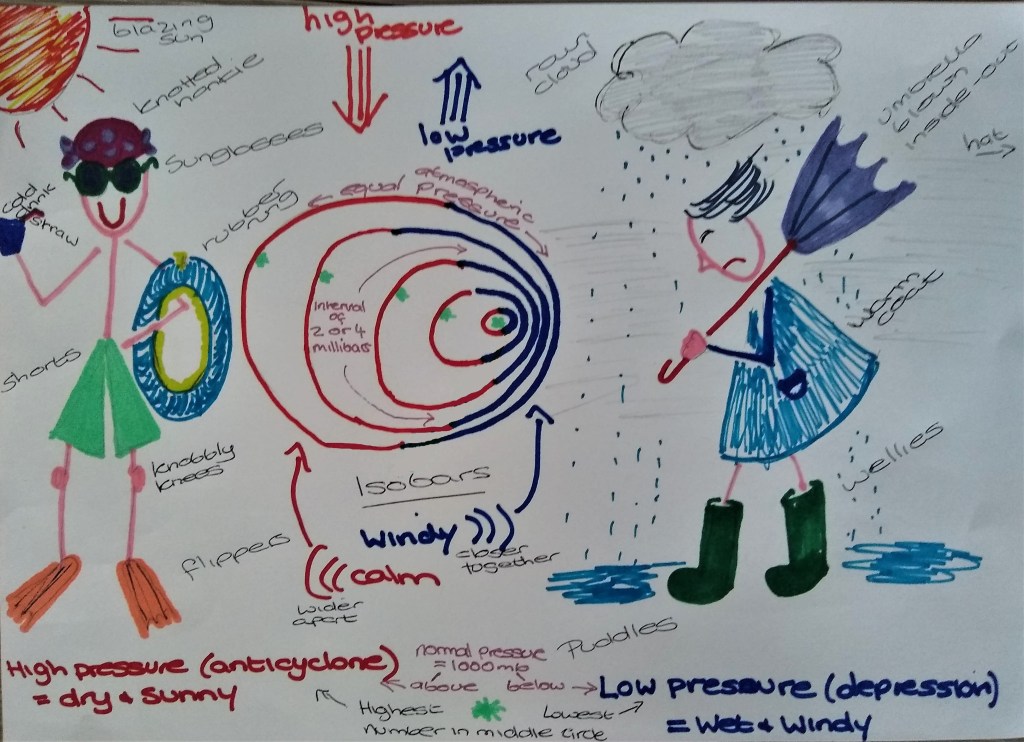
My illustration to remind me what isobars tell us and the effects of air pressure
A bit of fun while trying to remember the effects of air pressure and what isobars tell us